


A terraced house garden is rarely generous. You inherit a strip: perhaps five metres wide, twice as long, walled in brick on both sides and overlooked from half a dozen upstairs windows. It can feel like a corridor with a fence at the end. It can also be one of the most satisfying plots to design, because everything is visible, nothing is wasted and small changes read clearly. The trick is to stop treating it as a scaled-down version of a big garden and start thinking of it as a handful of connected rooms.
Work With the Long View
Spend half an hour in the garden before you buy anything. Note where the sun sits at ten in the morning, at one and at six in the evening. Note which neighbouring windows look down into the space, and from what height. Then ask yourself three questions:
- Where do I actually want to sit, and at what time of day?
- Which parts of the garden are overlooked, and when?
- Where does the space feel widest — usually right outside the back door?
The eye reads a long, narrow garden as a tunnel, and a single path running straight down the middle makes it worse: it pulls your gaze to the back fence and exaggerates the length. Interrupt that line. A pot, a change of surface, a shrub leaning across the path or a seat placed side-on will all slow the eye and make the garden feel broader.
Zoning a Narrow Garden
Three zones is usually plenty: somewhere to sit and eat close to the house, a planted middle, and a small destination at the far end — a bench, a shed painted to disappear, a single large pot. Two zones will do if the garden is very short.
Separate the zones subtly
A change of paving, a single sleeper step, a low hedge of lavender or box, or a run of tall grasses will signal a threshold without eating floor space. Keep the walking route to one side rather than down the centre; that frees a wider planting bed on the other side and stops the garden looking like a passageway.
Think about the view from indoors
You will look at this garden far more often from the kitchen window than from a chair in it. Put something worth seeing at the end of the sightline — a small tree in a pot, a sculpture, a dark-painted fence with pale-leaved planting in front of it. Lighter colours at the far end make a narrow space feel more open.
Paving That Earns Its Space
Hard landscaping usually does more for a small garden than planting does, at least in the first year. Choose one material and one tone, then repeat it. A patchwork of gravel, decking and slabs will chop a narrow space into fragments.
Materials worth considering
- Clay brick pavers — warm, in scale with a small garden and they tie the plot to the house. Herringbone or stack bond both work.
- Riven sandstone or limestone — softer underfoot and less slippery when wet than polished stone. Buy from one batch so the colour matches.
- Porcelain — consistent in colour, easy to clean, and a sound choice for a shady courtyard.
- Gravel — quick and inexpensive, good for a narrow side return, but noisy underfoot and it will travel indoors on your shoes.
- Decking — comfortable and light, provided there is ventilation underneath and it sits below the damp course.
Layout and drainage
Bands of paving laid across the garden, or a diagonal grid, read better than long lines running away from the house. Keep a proper sub-base under anything load-bearing, and maintain a fall away from the building — around 1 in 60 is typical — so water reaches a drain, soakaway or planted border rather than sitting against the wall. If the garden floods, or you are paving a front garden, check your local council's rules on drainage and permitted development before starting; they vary by area.
Going Up: Vertical Planting and Screening
Walls and fences are the largest surface in a terraced garden and the least used. Treat them as growing space.
Climbers
Fix trellis or horizontal wires about 50mm clear of the wall so air circulates and you can tie in growth easily. Star jasmine and honeysuckle suit a sunny, sheltered wall; climbing hydrangea, ivy and many clematis cope with shade. If the fence belongs to a neighbour, ask before fixing anything to it — better still, grow against your own house wall or use freestanding obelisks.
Screening without losing light
Horizontal slatted screens let light and air through while blocking a direct view, and they look calmer than a solid panel. A pergola over the seating area, clothed in a climber, gives privacy overhead without boxing the garden in. Where you need height quickly, use a clumping bamboo such as Fargesia; running bamboos need a root barrier and are best avoided in a small plot.
Pots and wall planters
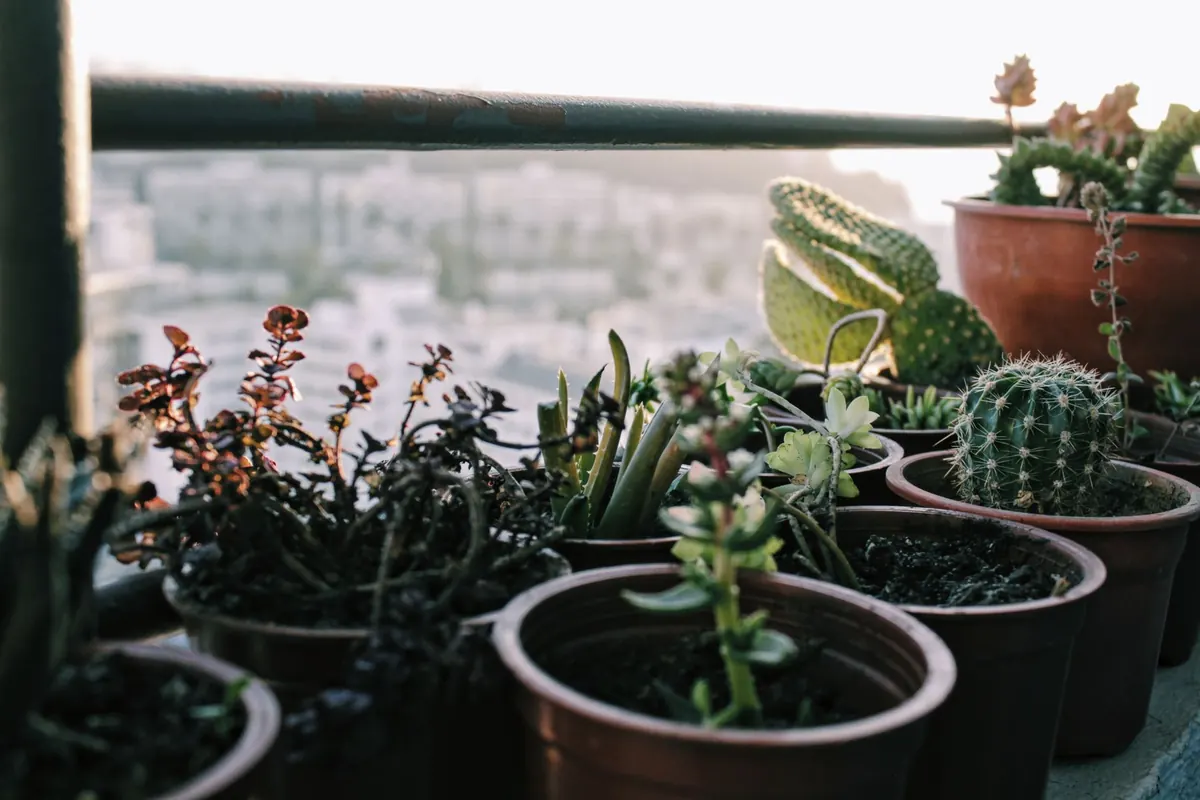
Fewer, larger pots beat a crowd of small ones and hold moisture better. On decking or a balcony, check what the structure can reasonably carry before filling a container with compost. A mirror fixed to a side wall can double the apparent width, but angle it to reflect planting rather than a neighbour's window.
Planting for Shade, Pots and Tight Roots
Soil in a narrow garden is often compacted, dry and full of rubble. Fork it over, work in plenty of compost and mulch each spring. In shade, ferns, hostas, epimedium,
Photo: Stefano Photography / Pexels